
By Viscontessa Elisabetta Tommaso di Carduci <[email protected]>, September 13, 2024
So, you want to register a name. Awesome! Sometimes, doing so can seem overwhelming as there is such a wealth of information available to us on the Internet. Not all of it is good information, which can make this task all the more daunting. Here are some tips to help the heralds help you better, when you are getting ready to document and submit your name.
Please note that you do not need to do all of the research yourself; if you get stuck, please reach out to a herald to help you! At the end of this article is a link to submissions herald contacts, organized by Kingdom. You can reach out to your Kingdom’s submissions herald and they can point you in the right direction.
1. Decide What is Most Important to You
This seems fairly straightforward, but in practice it is not. Do you want a name associated with a particular time and place? Do you want a specific spelling of a name no matter what time period it is from? Are you looking for a specific culture but are unconcerned with what time the name would have been used?
2. Start With Some Basic Site Resources
Once you know what is most important to you in a name, you can start looking for one. Start with heraldry.sca.org/names.html or www.s-gabriel.org/names. All the articles on these websites are what the College of Heralds calls “no-photocopy sources”. This means that you do not need to include copies of them with your submission when you send it in. The entire list of “no-photocopy sources” can be found here: Admin Handbook Appendix H. The names sources on this website are also excellent places to start.
To use these sources you need to include:
- The name of the article/book
- The author of the article/book
- The spelling of the name found in the article/book that you prefer
- The date this spelling is found
- The URL of the article/book if one exists
Q: But I can’t find my preferred name here, what do I do?
A: Never fear! You don’t need to give up hope. There are three additional resources available that might help you find what you are looking for but they require a little finesse to use correctly.
3. Using Advanced Resources!
FamilySearch
Using FamilySearch as a resource requires you to be extremely careful in what records you pull. Its primary purpose is not onomastics, it’s genealogy. That isn’t bad, but it does mean that not everything found here is going to be a period-attested spelling. This resource requires a free account to use.
Start a search here by going to www.familysearch.org. Click on ‘Search’, then on ‘Records’. Then click on ‘More Options’. Make sure that you click ‘Any’ under “Add Life Event”, and put the date range in the ‘Any’ field as 1151-1650. Records with images available are best, but records from the following batches are acceptable to the College of Arms: B, C, J, K, M (except M17 and M18), P and V. If you pull a name from this source, you must include the batch number and the link to the record. For example:

To use this record from FamilySearch I would need to include all of the highlighted information from it on the submission form. If your record does not have an approved batch number, you need to find other documentation supporting this name from period sources. This might be an accompanying image or it might be additional sources from other websites.
books.google.com
Google Books is a great resource because a wide variety of books have been digitized and are available here for free. However, a large number of these books, especially ones written in the 18th and 19th centuries, normalize all the names for their readers. This renders the reference useless for purposes of documenting the spelling of your name. A safe way to use this resource is by using its Advanced Search feature as follows:

Clicking on the drop menu next to “Any time” will give you the option to select “Custom range”:

You only need to fill in the “To” box. Enter 12/31/1650. This will ask Google to find only results with a publication date up through 1650. Doing this search gives me the following:
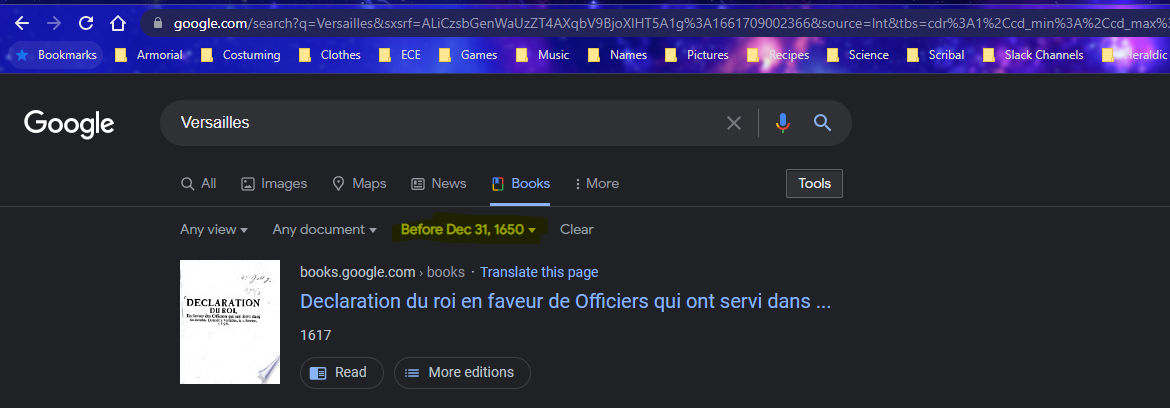
Note that every source returned now has a publication date before Dec 31, 1650, and any spelling found here will count as valid documentation for its publication date.
To use citations from Google Books as documentation you need to include the following:
- The title of the book
- The author of the book
- The publication date
- The URL to the Google Book
- The dated spelling of the name within this book
- A screenshot of the dated spelling within the book
archive.org
Archive.org is part of the Internet Wayback Machine project, and this online repository holds a large collection of digitized books not only from Google Books but also international libraries and universities. For this tool to be useful, you need to do some parsing of your search results as follows:
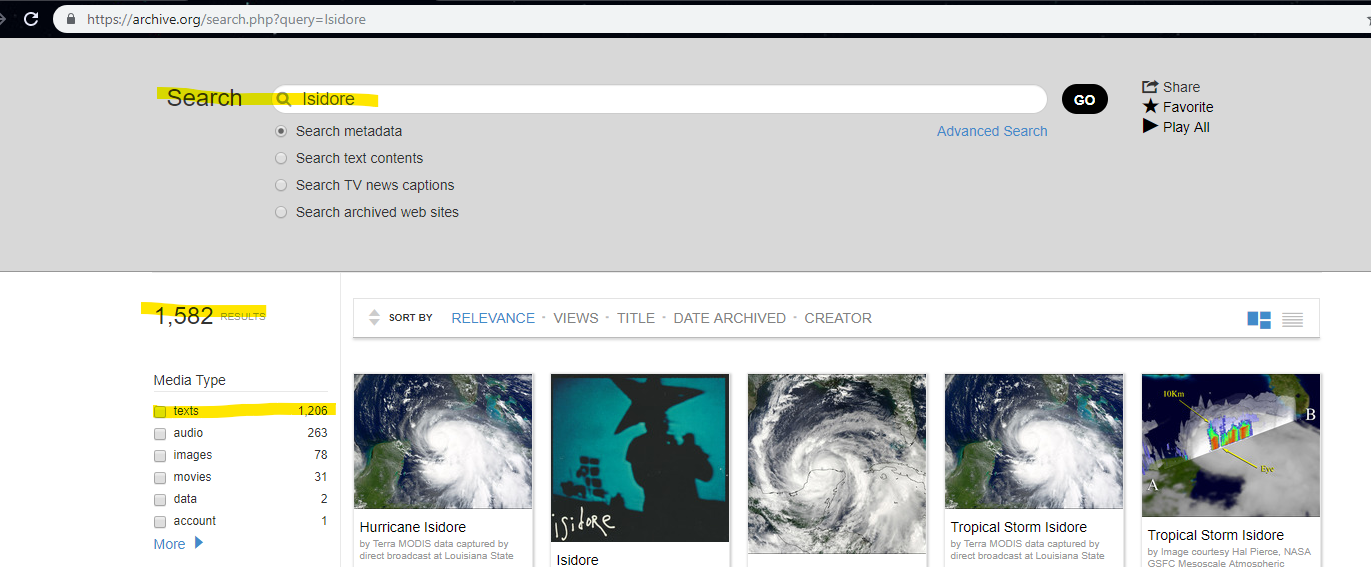
In this search for the name Isidore, I’ve come up with 1,582 hits. Note that these results can be further filtered! The first thing I will do to parse these results is select ‘texts’. This narrows my search results to 1,206 records. Next, I want to only see records that were published up through the end of the grey period (1650). I’ll scroll down to ‘Year’ and click the ‘more’ option. This should pop up a screen that looks like this:

There may be several screens of years to scroll through here. The years I want are on page 3 and the bottom of page 2. Selecting only these years and then applying my filters drops my results down to 13. This is much more manageable to look through than over a thousand records.
To use documentation from the Internet Archive, you must include the following:
- The title of the book
- The author of the book
- The publication date
- The URL to the book on archive.org
- The dated spelling of the name within this book
- A screenshot of the dated spelling within the book
Q: Found it! Woohoo!!!..... now what do I do?
A: Congratulations! Let’s fill out the form!
4. Filling Out Your Name Form

If this is the first name you are ever submitting to the College of Arms, your name will go in the “Society Name” field. Do not put anything under ‘Name Being Submitted’ if it is the same as ‘Society Name’.
You must provide either 1) a valid mailing address, 2) a valid phone number or 3) a valid email address. This is so that your Kingdom has some way to notify you what happens with your name submission.
Chances are, if you are using this guide, you will be selecting Name Type: Primary and Action Type: New.

This section of the form is important. This tells the College of Arms how they should amend your name if it cannot be registered as presented. If you have followed this guide, you should already know the answers to these questions.
If you check the box next to “I will NOT accept any changes to my name”, the Laurel office will have no choice but to return your name if it needs to be changed for any reason. This includes typos or small fixes for grammar.
If you check the box next to “I will accept the following changes to my name”, please be specific. If you only want Pelican Sovereign of Arms to be able to fix typos and make fixes for things like grammar, gender or lingual consistency, put that in the space provided. If you will only accept certain alternate spellings, or you will allow elements to be dropped or added for registration, you can also make those notes here.
If you check the authenticity box, please be specific! Good examples of an authenticity request are:
- 12th century Bavarian feminine name
- 16th century masculine Florentine name
- Authentic for the Spanish language
- Authentic for the 13th century in Wales
If you make an authenticity request, the College of Heralds will do their best to meet your request even if it means making large changes to your name. If meeting the request would require this but you have not allowed the changes necessary, you should be hearing from your submissions herald as Pelican will need guidance on whether the authenticity request or not allowing changes is more important to you. Your name may be registerable even if it is not authentic, as authenticity is not a requirement for registration.
It is important to note here that you do have an avenue to request that the College reconsider your name if Pelican makes a change to your name that you do not like. The information on how to do this can be found here: Admin Handbook Section IV.F.
In the Name Documentation field you must provide:
- A dated example of each element in the name in the spelling you want
- Where you found the documentation for each element
- What the name and title of the documentation is
- Documentation for the construction of the name
There is a handy chart found at SENA Appendix A that lists for you all the types of byname formations for which you need no further documentation.
Here’s An Example!
A good example of proper documentation can be seen here, for the Italian masculine name Antonio da Valenza:
<Antonio> is a masculine given name found 5 times in "15th Century Men's Names" by Brian Scott, https://www.s-gabriel.org/docs/italian15m.html.
<da Valenza> is a locative byname found 1 time in "15th Century Men's Names" by Brian Scott, https://www.s-gabriel.org/docs/italian15m.html.
The name construction given name + locative byname for Italian names is found in SENA Appendix A, https://heraldry.sca.org/sena.html#AppendixA.
Q. My form is done, now what?
A. Once your form is filled out, simply submit it! Find your Kingdom below for the process and contact information for your submissions herald: