Preface to the Second Edition
This second edition comes relatively soon after the first. The reason for this haste was that the first edition was never intended to be the definitive word on the subject. This edition also has no such pretensions. However, it is much closer to the desired end product. For example, the reader will notice the greatly expanded grammar section and particularly the alphabetical listing of name roots which (theoretically) will allow the careful user to create a period-sounding Russian name in "Chinese-menu" style by mixing and matching elements. All of these changes are in addition to approximately 10,000 more entries and a section of place names that has been nearly doubled. Another improvement has been the replacement of many secondary (and unreliable) citations with more accurate and primary sources wherever possible. Finally, the text has been reformatted into a double-column format and set in a proportional font (both of which make much better use of space).
I wish to thank the same people as before, but particularly Dr. Eve Levin for giving me a copy of her research notes that made it possible to replace many of the inaccurate entries for Russian saints with a more trusted list of medieval Russian saints. I am thankful for her support of a project which must seem terribly infantile in comparison to the work of professional medievalists. I am also thankful to Masha Holl (Predslava Vydrina) who arrived on the scene recently, but who has generously given me permission to include some of her own research within this work. If all goes according to plan, I hope to be able to collaborate more fully with her on the next edition. Until then, all the errors herein remain my own.
This dictionary is a work in process. I expect it to take several years to complete. For the next version, I hope to complete entering secondary sources and be able to turn my full energies towards primary source documentation. I welcome any comments and criticism, particularly if they can help to improve the quality of this work.
Paul Wickenden of Thanet
March, AS XXX (1996 CE)
Dr. Paul Goldschmidt
675 Staley Ave
Platteville WI 53818
608-348-6209
E-Mail: goldschmidt@uwplatt.edu
Preface to the First Edition
I do not have a Russian persona nor did I come to the Society with a deep interest in Russian history. I stumbled across this project in the process of helping my lady try to document her Russian name. Along the way, I discovered that the Society lacked a truly rigorous source on Russian names. Do not get me wrong. Tatiana Tumanova's Complete Book of Russian Names is truly impressive (in a way that could only be truly appreciated after attempting to replace it) and it has served well as the standard reference for many years. However, the Society's standards for name documentation have changed. There has been a growing need for a book which would provide not only definition, but also historical documentation. Tatiana's book, based in part on a Soviet baby-naming book, never had such pretensions. This project does.
This dictionary began in 1993 as a short booklet of 1000 entries and underwent numerous layout revisions and additions over the following year before reaching its current form. It is not limited to Russian names, but includes names used in medieval Russia originating from Ancient Greek, Latin, Ukrainian, Bulgarian, Serbian, Czech, Slovak, Hungarian, German, Turkish, and several other languages. Many of the spelling and transliteration variations found in the dictionary are not Russian at all. These are cross-referenced to the closest Russian equivalent and may be considered as suitable documentation for the Russian version of the name (more details are provided in the following pages). This version of the dictionary contains approximately 15,000 entries.
I am no expert on Russian onomastics. I have actively studied the Russian language in college since 1985. I have made numerous trips to Russia during that time. I have conducted fieldwork and archival research in Russia and I consider myself fluent in the language. I am active in various professional organizations that are devoted to Slavic studies. I also have the advantage of sitting on top of one of the largest Slavic library collections in the world (at the University of Illinois at Urbana-Champaign). However, I study contemporary Russian politics and I am not a linguist (I have taken a few courses on the subject). Nor, for that matter, am I a professional historian. Rather, I like to think that my level of expertise gives me a proper appreciation for just what my limitations are. I therefore want to stress that this work is not flawless and should not be taken as the cardinal truth.
This work has been (and continues to be) extremely time consuming. I am therefore very thankful to people who have guided me over the past year in getting this far. Jennifer Miller (Ilyana Barsova) contributed a list of feminine given names derived from primary sources (300 or so of which appear herein) and inspired me to get this far. Dr. Andrei Akhmatovich Zainouldinov, Assistant Professor of Philology at Saint Petersburg State University (Russia) made early editorial suggestions. Stephen Goldschmidt (Iulstan Sigewealding) and Brian Scott (Talen Gwynek) -- also PhDs, by the way, but it is not relevent here -- provided much appreciated comments and encouragement. Dr. Eve Levin, Director of the Center for Medieval and Renaissance Studies at Ohio State University, generously provided leads and criticism on this project. Finally, I must thank the staff of the Slavic Reading Room of the University of Illinois at Urbana-Champaign for truly making this project possible by providing me with the sources. While I owe the success of this work to all of them, the errors in this book are mine alone.
Paul Wickenden of Thanet
September AS XXIX (1994 CE)
For Ilyana --
Why else would a proper Anglo-Norman study Russian names?
Structure of this Dictionary
The first section of this dictionary is devoted to the grammar of Russian name construction, covering patronymics, locatives, descriptives, titles, and other issues for building a Russian name. It is heavily based upon my previously published material collected much of which is here for the first time.
The second section is an entirely new (and experimental) feature: a list of basic name roots (all period) and their meanings, with examples of usage provided. It is broken down into grammatical first elements and themes. An index at the end of the section is designed to aid in finding elements and themes by their meaning. In theory, it should be possible to construct period names by combining these root forms together. Rudimentary grammar notes are included.
The third section of the dictionary consists of personal names in alphabetical order. Each distinct name element has its own entry, although spelling variants and diminutives are cross-referenced to their "primary" entry. Instructions on reading the entries are provided below.
The fourth section of this dictionary is a list of medieval Russian towns intended to provide documentation for locative bynames. One should note, however, that geographical qualifiers have a complex grammar and cannot simply be tacked on to a name. Within each entry, I have tried to provide the correct spelling of the town, when it was founded, and any interesting characteristics that can be briefly summarized. I have not aimed at giving great detail and the list is not complete.
Sources
The following books were used to construct this dictionary. These sources are based on primary documents (or are primary documents themselves). Each source has its own particular strengths and weaknesses that are worth noting and keeping in mind when using them.
-
Atlas istorii geograficheskikh otkrytii i issledovanii [Historical Atlas of Geographical Discoveries and Surveys]. Moscow: Glavnoe upravlenie geodezii i kartografii MVD SSSR, 1959.
- Documents the opening of the east (i.e., Siberia) in late period.
-
Bazilevich, K. V., I. A. Golubtsov, and M. A. Zinov'ev. Atlas istorii SSSR [Historical Atlas of the USSR], Chast' pervaia. Moscow: Glavnoe upravlenie geodezii i kartografii MVD SSSR, 1959.
- Soviet historical atlas intended mostly for schoolchildren.
-
Bukharev, I. Zhitiia vsekh sviatykh [The Lives of All Saints]. Moscow: Tipografiia Vysochaishe utverzhdennogo T-va I. D. Sytina, 1896.
- As most of the books used here focus on Russian names only, a book of Russian saints was a necessary tool for finding baptismal names. Unfortunately, Bukharev's book is a list of saints worshipped in the 19th century. More period lists exist but are difficult to work from. Therefore, although obviously non-period saints have been deleted, the user should beware of late-period entries from this source as the saints in question may not have been canonized until after period. I also am not of the school to say that all Biblical names were used in period. Therefore, I would recommend caution in suggesting that the Russianized spelling of an Old Testament prophet, for example, is a period name (although I have included them here).
-
Chew, Allan F. An Atlas of Russian History. New Haven CT: Yale University Press, 1967.
- Rather pedestrian description of Russian history with maps.
- Gilbert, Martin. Russian History Atlas. New York: Macmillan Co., 1972.
-
Gramoty velikogo novgoroda i pskova [Official Documents of Velikii Novgorod and Pskov]. Edited by S. N. Valk. Moscow: Izdatel'stvo Akademii Nauk SSSR, 1949.
- A comprehensive collection of legal and diplomatic documents that cover most of the later period of Novgorod and Pskov's rule over the Russians. An excellent source for diplomatic accounts including many examples of how Russian names were spelled by foreignors in their dealings with the Russians.
-
Istoriia kul'tury drevnei rusi. Domongol'skii period. I: Material'naia kul'tura [The History of Ancient Rus Culture. Pre-Mongolian Period. Vol 1: Material Culture]. Edited by N. N. Voronin, M. K. Karger, and M. A. Tikhanova. Moscow-Leningrad: Izdatel'stvo akademii nauk SSSR, 1948.
- The map insert from this book provided a detailed list of towns and cities from the 9th to 13th century.
-
Levin, Eve. Calendar of Saints -- 12th-15th Century Novgorod.
- Eve Levin's unpublished research notes from Russian and Bulgarian archives form an attempt to create a complete calendar of the Russian saints that were worshiped in period. This is a much more reliable source than Bukharev, but still not proof that particular names were used in period.
-
Magocsi, Paul Robert. Historical Atlas of East Central Europe. Seattle: University of Washington Press, 1993.
- While this atlas covers the post-13th century period, it is far from complete and not consistent in spelling.
-
_____________. Ukraine: A Historical Atlas. Toronto: University of Toronto Press, 1985.
- Similar project for the southeastern region.
-
Moroshkin, Mikhail. Slavianskii imenoslov ili sobranie slavianskikh lichnykh imen [The Slavonic Name Book, or a Collection of Slavonic Personal Names]. Saint Petersburg: n.p., 1867.
- A dictionary of the roots of Slavic names. Provides a large number of spelling variants and diminutives (not all of which are Russian). Entries which do not resemble Russian forms should be treated with caution as this book is plagued with errors.
-
Novgorodskie gramoty na bereste [Novgorod Deeds on Birchbark]. Edited by A. V. Artsikhovskii, et al. Moscow: Izdatel'stvo Akademii Nauk SSSR, 1953-78. Seven Volumes.
- These books document all of the birchbark finds dug up in Novgorod. The Novgorod birchbarks record everyday transactions between normal people, ranging from IOUs to children's drawings to love letters. They provide a wonderful source for common naming practices.
-
Polnoe sobranie russkikh letopisei [The Complete Collection of Russian Manuscripts]. Saint Petersburg/Petrograd/Leningrad. 38 Vols.
- This set of books provides reprintings of all the major Russian primary documents from the 9-16th centuries, collected by the USSR Academy of Sciences (and its Russian predecessors). It is a standard text for historians of ancient Russia. As such, it provides the most reliable source for Russian names. It is a difficult work to use, however, and was consulted (so far) only to document certain female names which were skimmed out of volumes 1-22.
-
Russkaia istoricheskaia biblioteka [Russian Historical Library]. Saint Petersburg, 1875-1894.
- A collection of legal documents and court transcriptions from late-period. Valuable record of many people (both famous and obscure) who appeared in criminal and legal courts during the period. Although this is a multi-volume set, in this Dictionary only Volumes II, XII, and XIV were used. The other volumes are less useful.
-
Tikhomirov, M. N. Drevnerusskie goroda [Ancient Russian Cities], Second Edition. Moscow: Politicheskaia literatura, 1956.
- Available in an English translation as "Towns of Ancient Russia," this book documents the evolution of many towns in Russia, providing the earliest known references or founding dates for many of them.
-
Tupikov, N. M. Slovar' drevne-russkikh lichnykh sobstvennykh imen [Dictionary of Ancient Russian Personal Names]. Saint Petersburg: Tipografiia I. N. Skorokhodova, 1903. [Available in a reprint under the title: Tupikov, Nikolaj Michailovi_. Worterbuch der Altrussischen Personennamen. Cologne: Bohlau Verlag, 1989.]
- The mother of all Russian name books (some 857 pages of mostly pre-1600 names). This book is broken into three sections: masculine names, feminine names (only four pages!) and patronymics -- all arranged alphabetically. It is as reliable as a secondary source can be expected to be. So far, only the masculine and feminine given names sections (about 465 pages) have been entered into this Dictionary.
-
Veselovskii, S. B. Onomastikon. Moscow: Nauka, 1974.
- A Soviet name book. Useful for finding hard-to-find names, but the author modernizes spellings, thereby destroying unusual period orthography.
How to Use This Book
All names are listed under one entry only (and cross-referenced as needed from others). Patronymics (and bynames derived from nicknames) are listed under the given name that they are based upon. Patronymics are usually not cross-referenced unless they have unusual spellings. To find a patronymic without knowing the name it is based upon, you will need to follow the rules of Russian name grammar (see the Grammar section that follows). One should also be aware that many names listed as "patronymics" are also surnames or bynames.
The use of Moroshkin's dictionary of non-Russian roots for Russian names requires the use of heavy cross-referencing. The cross-referencing of such spelling variants may show variant transliteration styles or reflect the grammar of other languages (the heavy use of h's for g's in Ukrainian is an example of the latter). The primary heading (i.e., the one which the cross-reference leads to) should be considered the preferred Russian spelling of the given name. The preferred patronymic forms are discussed in the section on grammar.
The primary entry always appears in the masculine nominative case. For people wishing to employ these names, one should be aware that bynames sometimes appear in the genitive case and that (in any case) they must agree with the gender of the person (see the section on grammar below for details).
To use this list, simply look up the name desired. The listing will provide you with at least one citation for each form of the name which can be documented. Each entry includes full name, occupation (if known), date of original citation, and source. For example, if we look up "Vladimir," we would find:
- Vladimir (m) -- "to rule the land."
- Vladimir Vsevolodovich. Born in 1053. [Tup 87]
- Dims: Volodia (Volodia Kirilov, clerk). 1605. [RIB II 978]
- Volodymerko (Volodymerko Volodarevich). 1142. [Mor 47]
- Vars: Bladimir. 1040. [Mor 12]
- Valodimer (Valodimer Ondreevich). 1585-6. [RIB II 307]
- Val'dimar. 1181. [Mor 34]
- Vladimer (Vladimer Ondreevich, prince, Ivan the Terrible's cousin). 1558. [RIB XII 129]
- Vlodimer (Vlodimer Ol'g'rdovich', Kievan great prince). 1362-92. [RIB II 6]
- Volodimer. 1371-2. [Gra 31]
- Volodimer' (Briachislav, syn Iziaslavl', vnuk Volodimer'). 1021. [Tup 22]
- Volodimir. 1302. [Gra 64]
- Volodimir' (Great Prince Mstislav Volodimir' syn). 1130. [Gra 140]
- Wladimir. 892. [Mor 41]
- Wlodimiro. 1261. [Mor 43]
- Wlodzimir (Russian prince). 985. [Mor 43]
- Wlodzimirus. 1387. [Mor 43]
- Pats: Vladimirovich (Great Prince Iurii Vladimirovich). 1174. [Tup 462]
- Pat Vars: Volodimerewitz (Dimitre Volodimerewitz). 1503. [Gra 331]
- Volodimerich (Iurii Volodimerich Monomash). 1138. [Tup 22]
- Volodimerov (Vasilii Volodimerov syn Kositsyn, scribe). 1573. [RIB XIV 95]
- Volodimerovich (Prince Iaroslav Volodimerovich, of Novgorod). 1189-99. [Gra 55]
- Volodkovich [from Volodko] (Kokh Vasil' Volodkovich). 1633. [Tup 203]
- Pats (f): Vladimirovna (Princess Mstislava Vladimirovna). 1018. [Mor 122]
- Pat Vars (f): Volodimerna [from Volodimer] (Effim'ia Volodimerna, daughter of Great Prince Vladimir). 1138. [Lav 305]
This entry tells us that Vladimir is a masculine given name meaning "to rule the land." The primary entry is documented to 1053 on page 87 of N. M. Tupikov's Slovar' drevne-russkikh lichnykh sobstvennykh imen. There is also two diminutive forms and fourteen variant spellings listed. One masculine form of the patronymic is found (and five variants of it -- all based on variant spellings of the given name) and one feminine form (and a single grammatical and spelling variant of it). All abbreviations are defined below.
Transcription
The need for rigid standardization has proved particularly pressing as this work contains material gathered from sources spanning a millenia -- from the Russian Manuscript works dating back to the tenth century (written in Old Church Slavonic) to modern scholarly accounts by Russian and Soviet authors. The modern Russian language itself is represented by two forms of spelling (pre- and post-1917). To make matters worse, several other languages are also used, including Serbo-Croatian, Czech, Polish, French, English, German, and others, each with its own transliteration system (or systems). To make sense of all this, some order had to be established.
My system is the following: All names given in Latin letters are reproduced as presented in the original but are cross-referenced to the closest approximation of their (modern) Russian equivalent. Cyrillic alphabets are transformed to the post-1917 Russian alphabet and then transliterated into Latin letters. The result is a transliteration style that reflects how a modern Russian person would pronounce (or mispronounce) the name.
Because the Russian alphabet is not Latin-based, the transcription of characters into Latin script is a particularly touchy but important issue. There are many different acceptable methods for transcribing modern Russian into English (there are yet more methods used in German, French, Italian, Spanish, Portugese, and so on). The difference between the three dominant systems in the English language can be dramatic, as we can see in the diagram below:
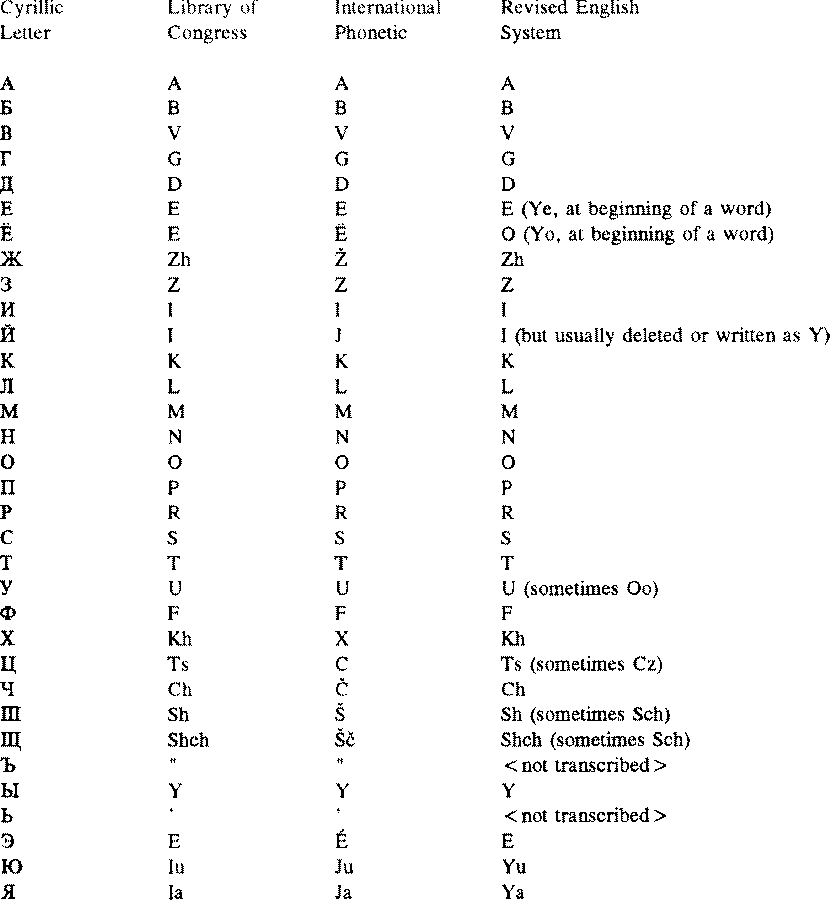
While Tumanova used both the Revised English and the Library of Congress systems, and Unbegaun used the International Phonetic system, I have transcribed consistently all names using the system of the Library of Congress only. The soft signs have been preserved with an apostrophe but the hard signs have been deleted. I have maintained this strict standard for reasons of orthography. There is no accepted standard for the pronunciation of medieval Russian names. The transcription system therefore can only tell us how names are pronounced in modern Russian.
This system is not perfect. It mangles entries which appeared originally in languages which voice their "hard" and "soft" signs (like Bulgarian). The system here has the advantage, however, of being a compromise between linguistic accuracy (the international phonetic system) and pedestrian oversimplification (the Revised English Standard). It also is the same system used in many North American card catalogs and the same system used by most North American historians.
List of Grammatical Abbreviations Used
anat			anatomical
byn  		byname
dim  		diminutive
f  			feminine given name
fem			feminine form
m	  		masculine given name
met  		metronymic/matronymic
met (f)		feminine form of metronymic/matronymic
met var 		metronymic/matronymic (variant spelling)
met var (f) 	feminine form of metronymic/matronymic (variant spelling)
obs			obscure
pat  		patronymic
pat (f) 		feminine form of patronymic
pat var		patronymic (variant spelling)
pat var (f)	feminine form of patronymic (variant spelling)
var 			variant spelling
List of Source Abbreviations Used
-
AIG = Atlas istorii geograficheskikh otkrytii i issledovanii. Moscow: Glavnoe upravlenie geodezii i kartografii MVD SSSR, 1959.
- Art = Artsikhovskii, A. V., et al. Novgorodskie gramoty na bereste, Vols I-VII. Moscow: Izdatel'stvo Akademii Nauk SSSR, 1953-78. [#'s indicate birchbark accession numbers]
- Avr = Polnoe sobranie russkikh letopisei, Vol XVI: Letopisnyi sbornik, imenuemyi letopis'iu Avraamki, 1st edition. Saint Petersburg: Tipografiia F. Eleonskogo, 1889.
- Baz = Bazilevich, K. V., I. A. Golubtsov, and M. A. Zinov'ev. Atlas istorii SSSR, Chast' pervaia. Moscow: Glavnoe upravlenie geodezii i kartografii MVD SSSR, 1959.
- Buk = Bukharev, I. Zhitiia vsekh sviatykh. Moscow: Tipografiia Vysochaishe utverzhdennogo T-va I. D. Sytina, 1896.
- Che = Chew, Allan F. An Atlas of Russian History. New Haven CT: Yale University Press, 1967.
- Erm = Polnoe sobranie russkikh letopisei, Vol XXIII: Ermolinskaia letopis'. Saint Petersburg: Tipografiia M. A. Aleksandrova, 1910.
- Gil = Gilbert, Martin. Russian History Atlas. New York: Macmillan Co., 1972.
- Gra = Gramoty velikogo novgoroda i pskova. S. N. Valk, ed. Moscow: Izdatel'stvo Akademii Nauk SSSR, 1949.
- Ist = Map insert from: Istoriia kul'tury drevnei rusi. Domongol'skii period. I: Material'naia kul'tura. N. N. Voronin, M. K. Karger, and M. A. Tikhanova, eds. Moscow-Leningrad: Izdatel'stvo akademii nauk SSSR, 1948.
- Kaz = Polnoe sobranie russkikh letopisei, Vol XIX: Istoriia o kazanskom tsarstve (Kazanskii letopisets), 1st edition. Saint Petersburg: Tipografiia I.N. Skorokhodova, 1903.
- Khr = Polnoe sobranie russkikh letopisei, Vol XXII (Pt 2): Khronograf zapadno-russkoi redaktsii. Saint Petersburg: Tipografiia M. A. Aleksandrova, 1914.
- Lav = Polnoe sobranie russkikh letopisei, Vol I: Lavrent'evskaia letopis', 2nd edition. Leningrad: Izdatel'stvo Akademii Nauk SSSR, 1926/1962.
- Lev = Levin, Eve. Calendar of Saints -- 12th-15th Century Novgorod. Unpublished research notes from Russian and Bulgarian archives.
- Lvo = Polnoe sobranie russkikh letopisei, Vol XX: L'vovskaia letopis', 1st edition. Saint Petersburg: Tipografiia M. A. Aleksandrova, 1910.
- Mag = Magocsi, Paul Robert. Historical Atlas of East Central Europe. Seattle: University of Washington Press, 1993.
- Mai = Magocsi, Paul Robert. Ukraine: A Historical Atlas. Toronto: University of Toronto Press, 1985.
- Mor = Moroshkin, Mikhail. Slavianskii imenoslov ili sobranie slavianskikh lichnykh imen. Saint Petersburg: n.p., 1867.
- Nik = Polnoe sobranie russkikh letopisei, Vols IX-XIV: Patriarshaia ili Nikonovskaia letopis', 2nd edition. Leningrad: Izdatel'stvo Akademii Nauk SSSR, 1862-1910/1962.
- Nov = Polnoe sobranie russkikh letopisei, Vol IV: Novgorodskaia chetvertaia letopis', 1st edition. Petrograd: Tipografiia M. A. Aleksandrova, 1915.
- Red = Polnoe sobranie russkikh letopisei, Vol XXII (Pt 1): Khronograf redaktsii 1512 goda. Saint Petersburg: Tipografiia M. A. Aleksandrova, 1911.
- RIB = Russkaia istoricheskaia biblioteka. Saint Petersburg, 1875-1894.
- Ste = Polnoe sobranie russkikh letopisei, Vol XXI: Kniga stepannaia tsarskogo rodosloviia, 1st edition. Saint Petersburg: Tipografiia M. A. Aleksandrova, 1913.
- Tik = Tikhomirov, M. N. Drevnerusskie goroda, Second Edition. Moscow: Politicheskaia literatura, 1956.
- Tup = Tupikov, N. M. Slovar' drevne-russkikh lichnykh sobstvennykh imen. Saint Petersburg: Tipografiia I. N. Skorokhodova, 1903.
- Ves = Veselovskii, S. B. Onomastikon. Moscow: Nauka, 1974.
- Zap = Polnoe sobranie russkikh letopisei, Vol XVII: Zapadnorusskaia letopisi, 1st edition. Saint Petersburg: Tipografiia M. A. Aleksandrova, 1907.
- Art = Artsikhovskii, A. V., et al. Novgorodskie gramoty na bereste, Vols I-VII. Moscow: Izdatel'stvo Akademii Nauk SSSR, 1953-78. [#'s indicate birchbark accession numbers]